
I’ve added a running list of books heartily begun or fully read by me, towards the bottom of the page, “Words: Consumed and Enjoyed.”
One such book was a gift from a sister: The Biblical Rembrandt, by John I. Durham. This book is not written from the perspective of an art historian, but, “a teacher of the Tanak, and a tender of its Hebrew roots.” John I. Durham has spent 50 years studying the Jewish Bible (Old Testament), which certainly makes him an authority on the same, but also an unusually enthusiastic voice for the study at hand–the Biblical works of Rembrandt.
One of my favorite excerpts is a commentary on the Stoning of Stephen:
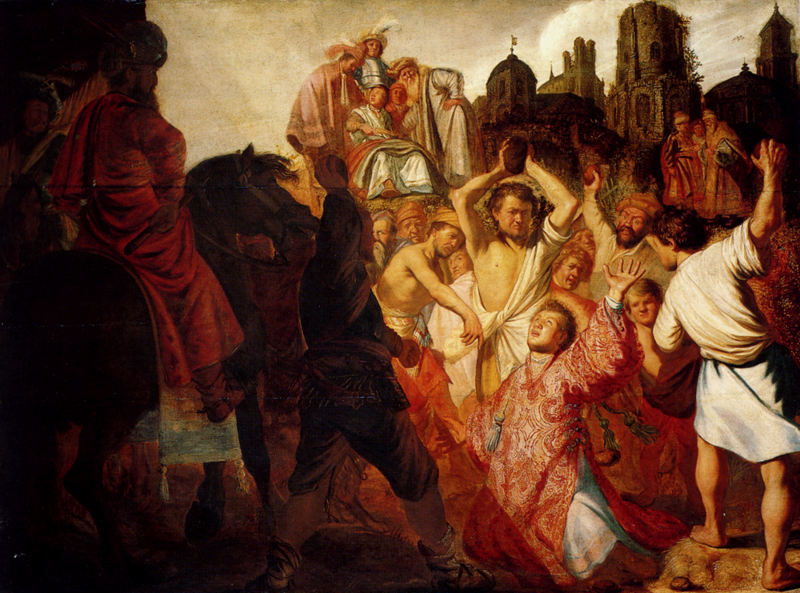
Rembrandt saw no reason to prettify the candid biblical account or to present it as anything more than the shocking reality is is. It was the murder of a man innocent of the wrongdoing of which he was accused. Angels flapping around and offering hands of comfort and laurel wreaths might have made the painting more acceptable to Dutch Catholics, but there were no angels on the scene in the text, so the young painter would not include any. His one concession to the transcendent is based solidly on the verses just preceding the moment of the stoning, Acts 7:55-56:
Stephen, however, full of the Holy Spirit, his eyes fixed on heaven, saw the glory of God, and Jesus standing at God’s right. “Look!” he said, “I see the heavens split open, and the Son of Man standing at God’s right.”
…
Kenneth Clark said, “Rembrandt never allowed himself to be deflected from the truth by the beautiful falsehoods of classical imagery.” I would add that he also never allowed himself to be blinded to the reality of the Bible as a human book for humans by the need of the church to be comfortable [emphasis added]
Durham, John I. The Biblical Rembrandt. Macon: Mercer University Press. 2004. 22-23.
Harmenszoon van Rijn, Rembrandt. The Stoning of Stephen.oil on panel.1625.
Musee des Beaux-Arts, Lyon
 The Weekend Design