Modern Houndstooth


Blanchett in Balenciaga Edition

Rosamund Pike & L.K. Bennett London



David Roentgen (1743-1807) designed and built furniture in the late 18th century for the imperial courts of Europe. He was soon a favorite of Catherine II of Russia, as well as the French court of Louis XVI. His work espoused the intricacy of the Rococo period. The Rococo period, as you will recall, followed the Baroque period in Europe, and embraced craftsmanship and detail, with frequent use of curves. Touches of the Baroque were also present in Roentgen’s monograms and marquetry. Through his career, Roentgen transitioned to the neoclassical.
marquetry
noun. A type of decorative veneer applied to furniture, made up of a sheet of small pieces of colored woods and often other materials such as ivory, mother-in-pearl, and bone, which were laid out in a pattern and then applied to the carcass… .
The craftsmanship of Roentgen, however, centers on the intricacy of his work–the mystery of inner pulleys, mechanisms, secret compartments, and transitional pieces. The videos below illustrate this genius–regardless of one’s aesthetic. Sadly, the French Revolution hearkened the demise of Roentgen’s workshop; his career never recovered, though his pieces are treasured today. To see a more complete catalog of his pieces, see the MET’s current exhibition.
"Marquetry." Miller, Judith.  A-Z of Antiques & Collections. First Edition.
2008. Print. "David Roentgen."  Miller, Judith.  A-Z of Antiques & Collections.
First Edition. 2008. Print.
Jessica Chastain recently made the cover of Vogue‘s December issue. The photographs and concept were developed by Annie Leibovitz, with inspiration from paintings and photographs, alike. Read here. Fantastic.

Also, enjoyed the short below.
Mariano Fortuny is credited for his contribution to the world of fabric and clothing design. He is widely held to have been unenthused with the ever changing world of fashion. Rather, his designs and form remained the same throughout his career, with change in color and fabric, exclusively. I’ve read he was considered to be an artist, who made clothing.
(1) Fortuny was an artist, with expressions in painting, drawing, architecture, photography, inventions, and fabric. Fortuny registered 22 patents from fabric design to theatre lighting. His father, Mariano Fortuny y Marzal, preceded him as a Spanish artist whose work is noted:


(2) Quintessential Fortuny: the Delphos pleat. Still being sold for thousands. The gowns are of pleated silk; the pleats were created through a patented process. The garment was meant to adhere to the woman’s form with fluidity. One size fits all. These gowns, to be worn with minimum undergarments, were considered provocative at the time when traditional undergarments, such as the corset, were burdensome and expected. The bold (and often famous) were the first to don these gowns.


(3) The company continues to operate out of his original Venetian factory and sell fabric from its early roots. It continues to represent Venice, luxury, and attention to an artisan’s detail; it recently released a limited stock of discontinued fabrics from as early as the 1960’s.


Mariano Fortuny y Marzal. An Ecclesiastic. 1874. Oil on Panel.
Mariano Fortuny y Marzal. The painter's children, María Luisa and Mariano,
in the Japanese Room. 1874. Oil on Canvas. Museo Nacional del Prado.
To take photographs means to recognize–simultaneously and within a fraction of a second–both the fact itself and the rigorous organization of visually perceived forms that give it meaning. It is putting one’s head, one’s eye and one’s heart on the same axis.


The creative act lasts but a brief moment, a lightning instant of give-and-take, just long enough for you to level the camera and to trap the fleeting prey in you little box.


Your first 10,000 photographs are your worst!


As far as I am concerned, taking photographs is a means of understanding which cannot be separated from other means of visual expression. It is a way of shouting, of freeing oneself, not of proving or asserting one’s own originality. It is a way of life.


Henri Cartier-Bresson. Matisse. 1944.  Henri Cartier-Bresson. Jean-Paul Sartre. 1946.
Henri Cartier-Bresson. Jeronimos Monastery, Belem, Lisbon, Portugal. 1955.
Henri Cartier-Bresson. Presidential Campaign. 1960.
Henri Cartier-Bresson. Daughters of the Confederacy. 1960.
Henri Cartier-Bresson. Tent City, Near Somerville, Tennessee. 1961.
Henri Cartier-Bresson. Torcello Near Venice. 1953.
Henri Cartier-Bresson. Pierre Bonnard, Le Cannet, France. 1944.
Henri Cartier-Bresson. Ann Arbor Michigan. 1960.
Henri Cartier-Bresson. Dessau, Germany. 1954.
Henri Cartier-Bresson. Brie, France. 1968. Henri Cartier-Bresson. Shanghai. 1948.
Tend to hedge towards neutrals at home. My family room being the example at hand:


But, for my office, I have intended to indulge, permitting print and color, so as to express and facilitate creativity. One of my ‘besties’ helped me pull the trigger on the rug below. My eye is slowly adjusting to the depth of color and the confidence in my satisfaction is quickly developing. Few other projects to go before this room will feel complete, but the momentum is palpable.


Endlessly enamored with the femininity, glamour, and intricacy of his collections. Take-aways from Fall 2013: form, color (pungent), print, and classic lines (Notice the touch of Chinoiserie?).


Take-aways from Spring 2014: form (as always), color (light and lovely), florals, and a touch of the 60’s.


Photos courtesy of Vogue.com.
I’ve added a running list of books heartily begun or fully read by me, towards the bottom of the page, “Words: Consumed and Enjoyed.”
One such book was a gift from a sister: The Biblical Rembrandt, by John I. Durham. This book is not written from the perspective of an art historian, but, “a teacher of the Tanak, and a tender of its Hebrew roots.” John I. Durham has spent 50 years studying the Jewish Bible (Old Testament), which certainly makes him an authority on the same, but also an unusually enthusiastic voice for the study at hand–the Biblical works of Rembrandt.
One of my favorite excerpts is a commentary on the Stoning of Stephen:
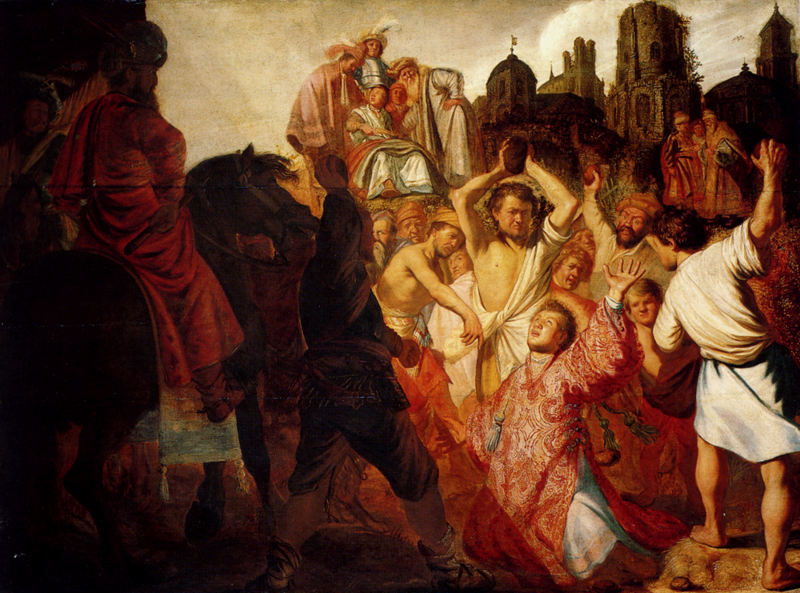
Rembrandt saw no reason to prettify the candid biblical account or to present it as anything more than the shocking reality is is. It was the murder of a man innocent of the wrongdoing of which he was accused. Angels flapping around and offering hands of comfort and laurel wreaths might have made the painting more acceptable to Dutch Catholics, but there were no angels on the scene in the text, so the young painter would not include any. His one concession to the transcendent is based solidly on the verses just preceding the moment of the stoning, Acts 7:55-56:
Stephen, however, full of the Holy Spirit, his eyes fixed on heaven, saw the glory of God, and Jesus standing at God’s right. “Look!” he said, “I see the heavens split open, and the Son of Man standing at God’s right.”
…
Kenneth Clark said, “Rembrandt never allowed himself to be deflected from the truth by the beautiful falsehoods of classical imagery.” I would add that he also never allowed himself to be blinded to the reality of the Bible as a human book for humans by the need of the church to be comfortable [emphasis added]
Durham, John I. The Biblical Rembrandt. Macon: Mercer University Press. 2004. 22-23.
Harmenszoon van Rijn, Rembrandt. The Stoning of Stephen.oil on panel.1625.
Musee des Beaux-Arts, Lyon
Read about Tom Scheere in the August issue of New York Time’s T Magazine. His. Interiors. Take a peak and notice the common elements: circles, attention to form, and ease–without fear of print and color and plants in most every room. He apparently has a thing for Ikea, which is hard to ridicule. So much to take from his thoughts and this excerpt:
‘Look at a floor plan of a David Adler house and compare it to a fancy house today–these’s such a discrepancy.’ The lesson is one for decorators and clients alike: don’t build so big; don’t mistake complication for quality; and don’t try so hard.
Look at your spaces and study his. Notice the ease by which your eyes track each component of his interiors and ‘don’t try too hard,’ yourself!


Photos courtesy of Tom Scheerer Incorporated.

 The Weekend Design